

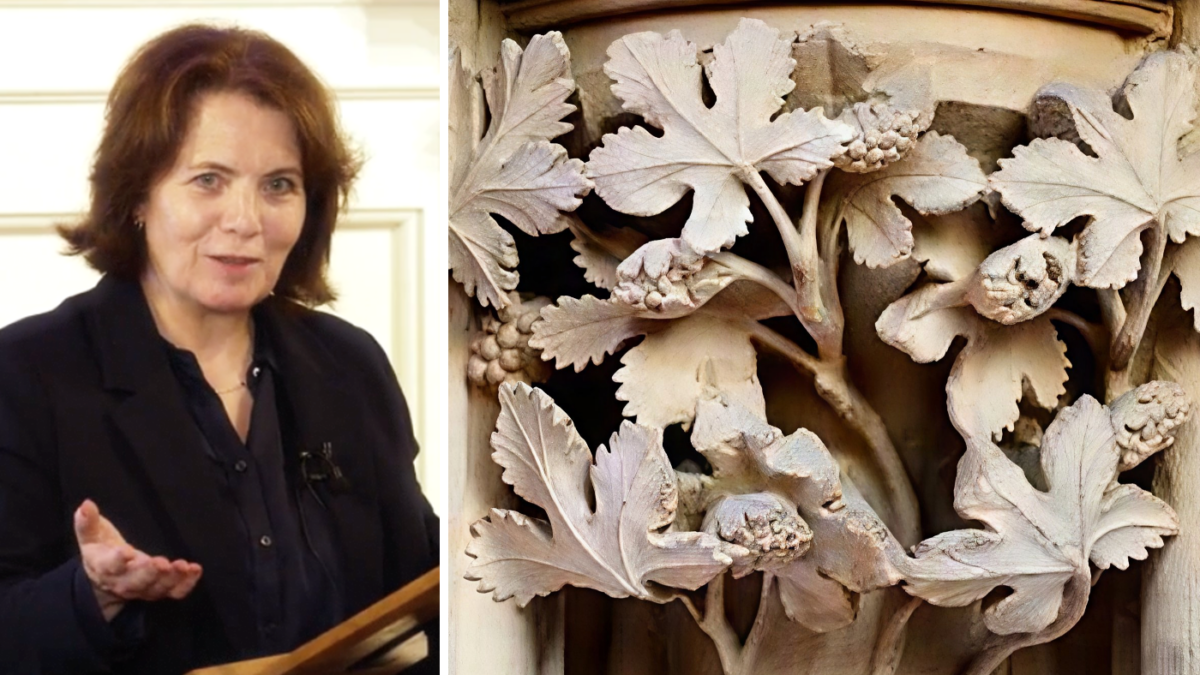
Jenny Sinclair reflects on the deep political, economic and cultural changes that have reshaped Britain, leaving communities fractured and feeling abandoned. Her lecture at Southwell Minster in Nottinghamshire draws on Catholic social teaching to challenge both the political establishment and the churches to confront the roots of this unravelling. She argues that rebuilding solidarity, strengthening local institutions and recovering a Christianity rooted in relationship, place and truth are essential to renewing our common life. Download a pdf of the talk here
Christianity, Politics and the Common Good
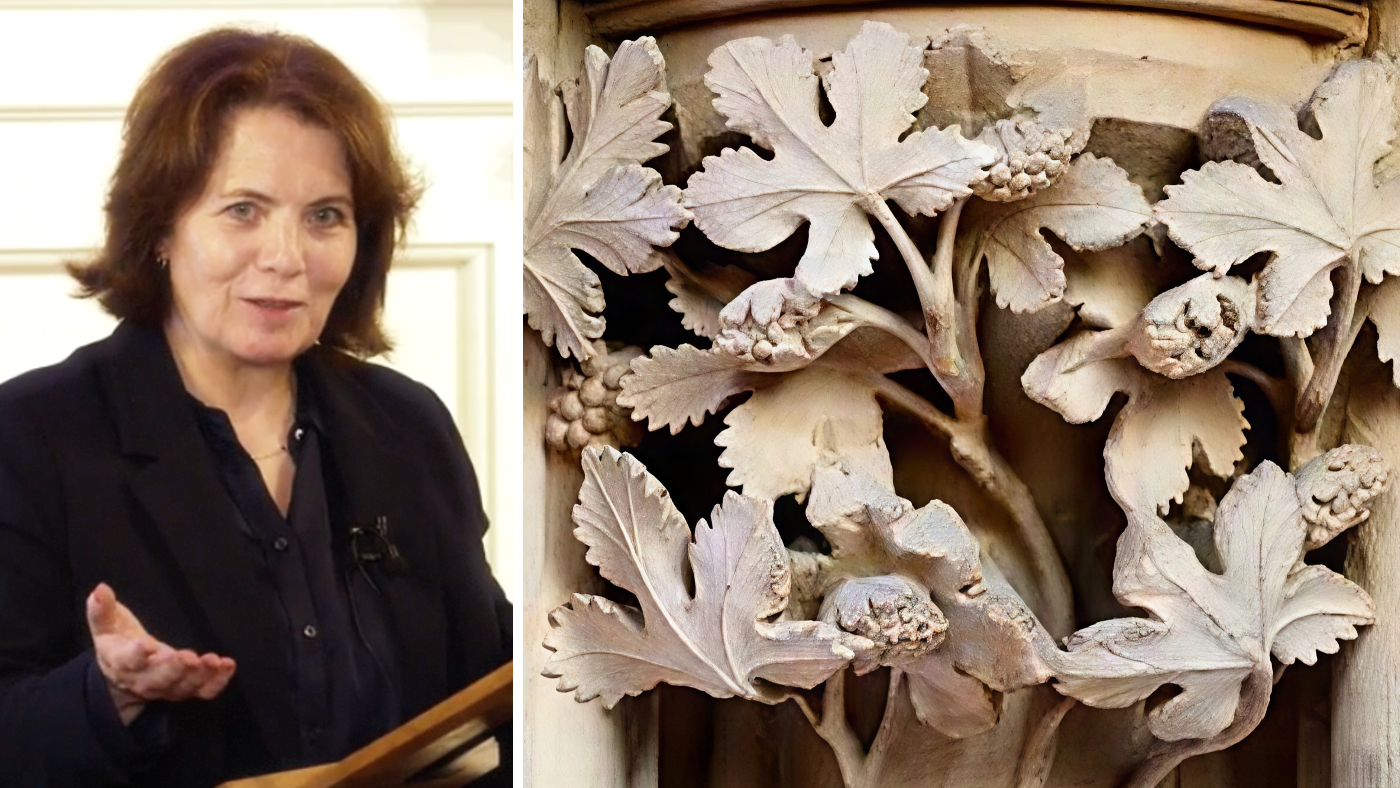
It’s a great privilege to be here. This is my first time at Southwell, and as I prepared, two things struck me. The first was the Chapter House. Around 1290, masons working here carved the capitals and arches with leaves – the famous Leaves of Southwell – and among them, peering out, the Green Men. Look closely and you see that the leaves are not stylised. They are true: hawthorn, maple, oak, vine, ivy, buttercup. The carvers went out into the hedgerows, looked hard at what was actually growing, and made it permanent so that we would remember. I want to hold on to that image – people who looked hard at reality, and out of that attention made something of lasting beauty.
The second is a mile up the road. The Southwell Workhouse, built in 1824, became the blueprint for the New Poor Law of 1834. It was designed as a deterrent. On arrival, families were split apart and rarely allowed to meet. Its austere regime was credited with drastically cutting the local poor rate. It was the answer of its day to the question of what to do with the poor.
So here, in one small town, we have two answers to the question of what a human being is. In the Chapter House, the creature is placed within a God-given order, and close attention to what is real becomes beauty and praise. In the workhouse, the person is a problem to be managed, and the bonds of relationship are an administrative inconvenience.
Today is the feast of St Luke – Luke the evangelist of the poor, and Luke the physician. So I’m going to take a physician’s approach this afternoon: diagnosis first, and only then the cure.
Standing in this beautiful Quire, I feel something like an envoy from another country. What I am going to say feels somehow at odds with this place of peace. But I think we all know it at some level. Our country is in trouble. Discontent is widespread and civic peace is under real strain. Communities are estranged from one another, living in different realities and getting their information from different sources. Increasingly they cannot hear each other.
My frame for all this comes from St Paul: “The body is not made up of one part but of many… The eye cannot say to the hand, ‘I don’t need you!’… If one part suffers, every part suffers with it.” (1 Corinthians 12)
A country is like a body. If one part is wounded and angry, it is not wise to ignore it, and if it is repressed, the whole body grows sick. I don’t say this to provoke guilt or fear. I say it because we avoid uncomfortable truths at our peril. Facing reality is in all our interests.
I’ve been asked to speak about Christianity, politics and the common good. You may think you know what’s coming: a winsome talk on togetherness and community, a call to disagree well, perhaps, or to support local welfare projects.
Well — not exactly. Some of what I want to say may challenge you, so let me warn you now. I believe we are in the midst of a deep unravelling. And a vision of the common good offered without an honest diagnosis risks becoming part of the delusion it is meant to cure.
Where I’m coming from
Let me tell you a little about where I’m coming from.
I grew up in an Anglican household. My father was David Sheppard, Bishop of Liverpool. His partnership with the Catholic Archbishop, Derek Worlock, and other church leaders became well known through the instability and unemployment of the 1970s, 80s and 90s. The language of church, justice and politics was the soundtrack of my childhood.
But I was a rebel, much more interested in Liverpool’s music scene. In my early twenties, while I was estranged from the church, my father was at the height of his mission. In 1983 he published Bias to the Poor. In 1984 he gave the Dimbleby Lecture, The Other Britain. And in 1985 he was one of the driving forces behind Faith in the City. I’ll come back to that era, because I think it holds an important lesson for us now, a lesson which might surprise you.
In my mid-twenties I had a conversion experience, and to everyone’s surprise, including my own, I was received into the Catholic Church, thirty-eight years ago. Later, in 2011, I sensed that something was going badly wrong in our country: the politics of left and right were both failing, and the churches didn’t seem to be able to respond adequately. Out of that, by God’s grace, came Together for the Common Good, a small charity working across the Christian traditions for spiritual and civic renewal.
My lens is Catholic social thought, which I regard as the most coherent theological frame we have for reading the world. It is rooted in Scripture, and its modern form began in 1891 with Rerum Novarum, the Church’s response to the industrial revolution. Cardinal Manning – himself a former Anglican – had a hand in shaping it after the London dock strike. It was offered from the start to all people of goodwill. It trains us to look at what is happening to the human being, across the whole of life: family, work, capital and labour, the state, local institutions, war and peace. It is non-partisan, both radical and conservative. It is not communitarian sentimentality, and it is incompatible with the identity politics that has lately hijacked the language of social justice.
A revolution misunderstood
So, the diagnosis.
There is a scene in Orwell’s 1984 that I find haunting. Winston Smith follows an old man into a pub. He wants to ask him one question: what was life like before the revolution? Better, or worse? The Party claims to have improved human life, but no one can test the claim, because no one can remember. The old man can recall only fragments, such as an argument about why he can’t have a pint instead of half a litre. He remembers the trivia, but he has lost the frame by which to judge it.
I think something like that has happened to us. Over the last half century we have lived through a revolution. In its modern political form it began around 1979 under Thatcher and Reagan. It was deepened by the Blair government, and continued by governments of both parties since. Its roots go back much further, to the Enlightenment, and perhaps even before. And those who remember what was lost are told they are being nostalgic – a word often used to delegitimise memory. When memory is discredited, a society loses the means to test what is happening.
Some have named it neoliberalism, usually understood as a purely economic phenomenon: markets, privatisation, deregulation. But it was far more than that. It was a philosophy with economic and social outworkings, on the right and the left, reaching deep into our families, our neighbourhoods, our institutions, our sense of who we are. Because its true nature was never grasped, most of us didn’t notice how much was changing. It became the sea in which we swim.
Its animating idea is an extreme strain of liberalism – hyper-liberalism. Let me be fair: in its moderate form, liberalism has done real good, in civil rights, in protecting the individual against discrimination. But at its core, hyper-liberalism holds a particular idea of freedom: freedom from constraint. Taken to its logical conclusion, that becomes freedom from family, from religion, from place, country and borders, from history. Then from God. In the end, freedom even from human nature – and from reality itself. And a culture that seeks freedom from reality will, in the end, be unable to recognise it.
The trouble is that this rests on a false anthropology – a mistaken idea of what a human being is. Its picture is the “unencumbered self”: the autonomous individual, isolated and self-authoring, a bundle of preferences and rights competing in a marketplace. A desiccated, soulless idea of the person.
The Christian story begins somewhere completely different. We are made in the image of a God who is Father, Son and Holy Spirit, an eternal communion of persons. A creature made in his image cannot, at root, be a solitary actor. We become fully ourselves only in relationship with one another and with God. As Catherine of Siena put it, God deliberately did not give everything to any one person, “so that we may be constrained to practise charity towards one another.”
Politically, hyper-liberalism produced a blind spot on both sides. The Right correctly blames our moral unravelling on excessive liberalism, but gives the neoliberal economy a free pass. The Left correctly blames inequality on that economy, but embraces unlimited self-actualisation and calls it “progressive”. Both were captured by versions of the same dogma, and the result was a consensus we can call progressive globalisation. It offshored our industries and called the wreckage “progress”. It required the free movement of capital and labour, and a low-wage model to go with it. Whole communities were told that their rootedness, their loyalty and their skills were obstacles to be overcome. That is a politics of abandonment – a breach of the common good.
All our political parties have been in some way colonised by this philosophy. Labour detached itself from the working people it was founded to represent. The Conservatives lost their instinct to conserve. Reform channels the anger but retains free-market economics. Restore drifts towards identity-based ethno-nationalism. The Liberal Democrats swapped classical liberalism for an illiberal progressivism.
The unravelling
A philosophy that works against the grain of who we really are carries the seeds of its own undoing, and it is unravelling now, all around us.
You can see it in a dysfunctional economy, with inequality and vast debt; in collapsing trust, divisive identity categories, rising tribalism; but also in loneliness, in family breakdown, addiction and a crisis of meaning. You can see it in the commodification of the human being: in abortion and assisted suicide, in commercial surrogacy, in the new industries of extreme body modification.
And you can see it in the hollowing out of human-scale institutions – clubs, churches, pubs, union branches, the small high street business – and the vast welfare apparatus that has grown up in their place.
Fraser Nelson, who is leading The Times’s inquiry into welfare, sets this out starkly. Britain has never spent more on welfare; spending on the sick and disabled has almost doubled in twenty years. And yet deaths of despair – from drink, drugs and suicide – are rising here while they fall across Europe. Every day around a thousand more people are signed on to sickness benefit. And because the gaps in the workforce can be filled by immigration, politicians have had the option of never reforming welfare at all. Nelson quotes Alison Dunn of Citizens Advice in Gateshead, who reckons that it takes thirty years for a social problem to meet a government solution. We are effectively talking about people who are being written out of the future.
Anger in the body
The people who noticed first were the working class: the canary in the coal mine, because they suffered first. When jobs went overseas, they bore the loss, and as work disappeared, the state stepped in with welfare. And over time, the benefits system, expanding far beyond its original intentions, brought unintended consequences. It entrenched dependency, and rules that penalised couples for living together contributed to fatherlessness across generations. When migration came at a pace and scale nobody had voted for, these communities then also saw pressure in their schools, their surgeries and their housing lists. And when they objected, they were met with derision and branded bigoted.
David Goodhart is right: for most people the revolt was never fundamentally racial. It was about pace, scale and the absence of a democratic mandate, and it was cultural. So we should not be surprised by what happened next. People in deindustrialised towns looked at what globalisation had done and they voted against it. Brexit was, among other things, an assertion of sovereignty, a demand for some purchase on their own future. After gross mismanagement by successive governments, that demand has intensified. There is anger in the body.
Nelson found that where deaths of despair have risen fastest, support for Reform runs about twelve points higher than elsewhere. Whatever you think of any party’s solutions, the demand is not irrational. It is a logical and political response of people who have been written out of the future.
The economist Karl Polanyi saw this pattern a century ago. Dissolve people’s solidarities, and they do not quietly disappear; they find solidarity elsewhere. That can harden into something narrower and sometimes ugly, or it can turn towards renewal. Which way it goes depends on how concerns are responded to.
And yet the establishment instinct, here and across Europe, has been to manage this anger, to suppress it, to reach for controls on speech. A system that cannot admit its failures must silence those who name them. That is not only counterproductive, it is dangerous. Every attempt to silence an organic anger fuels further suspicion. Governments are feeding the very unrest they fear. Ignore the wound, or try to repress it, and the sickness spreads to the whole body.
A nation, like a person, has to do its shadow work: face what it would rather not see in itself. What people long for is moral clarity, not moral purity. Purity insists that the good people are all on one side. Clarity tells the truth about good and evil wherever they are found, including in ourselves. Too often our leadership class lacks the courage, or even the ability, to tell right from wrong.
So let me say the hardest thing plainly, because the common good is nothing without truth. For years, girls have been raped and trafficked by organised gangs while the institutions that should have protected them looked away. Polite society, including the church, preferred to pretend it wasn’t happening. Baroness Casey’s national audit last year found that the ethnicity of perpetrators had gone unrecorded in around two-thirds of cases, and that organisations had avoided the issue for fear of appearing racist. A statutory inquiry is now under way, but justice has yet to be done. Turning away from the wounded member of the body leads a country into delusion. Without truth, good intentions become cheap grace.
The same honesty applies to religion. A relativistic culture that treats every belief system as of equal value has steadily downgraded Christianity, and left many leaders unable to speak the truth about Islamism. Christ was “full of grace and truth”. So we must be absolutely clear that our Muslim neighbours are loved by God, and that many are themselves victims of extremism. And in the same breath we must be equally clear that Islamism – as distinct from Islam – is a political ideology that seeks to place religious law above the law of the land. Even Muslim-majority countries recognise its menace; Egypt, Saudi Arabia and the UAE, for example, have designated the Muslim Brotherhood a terrorist organisation. But here, the doctrine of multiculturalism let communities live parallel lives, and in some of them an aggressive Islamism has taken root.
We should also notice a strange alliance. Parts of the progressive left and political Islam have found common cause in an anti-Western mindset. Well-meaning people are drawn in through the language of justice – and end up casting Christianity as an oppressor. That is a manipulation, and we should name it. Refusing to see the danger is not tolerance. It is a failure of responsibility, not least to those who came here to flee Islamist violence, and to the British Muslims who want to live freely under one law with everyone else.
And yet it is very hard to talk about this. Why has a philosophy that promised freedom led to coercion? Because people know it goes against natural justice, and a system that does this needs ever more control to hold it in place.
The first duty of government is to provide the conditions for civic peace – which is more than the absence of violence. On that test, our governments have failed.
What of the church?
What about the church? The churches have not been exempt from the flawed anthropology I’ve described. Mission drift rarely announces itself. It creeps in, often disguised in the language of justice, so that Christian distinctiveness gets captured: the moral vision reduced to activism, managerialism displacing conscience, relativism making us reluctant to tell the truth, energies turned inward; and charity – which simply means love – reduced to service provision.
You can hear it in the language: “outreach”, “the marginalised”, “service delivery”. It is well meant, but it is the language of a provider, not of solidarity. Think of the workhouse up the road. Its error was to treat the poor as a category to be managed rather than as neighbours with families, histories, gifts and agency. That same error can persist today in some of our charitable efforts, though I know there are many excellent examples of work that empowers, recognises people’s gifts and builds agency. The problem arises when help, however compassionate, treats people primarily as recipients rather than as neighbours with something to give. Unintentionally, it can trap people in that role, making it harder for them, as well as for us, to see what they have to offer. A working-class friend put it bluntly: “The church has alienated working-class people by turning into a woke food bank. It needs to start acting like a church again.”
I have listened to senior church leaders speak eloquently of “hope” and “the cure of souls”, and of the common good, without being clear about what they mean. They seem unable to name what has happened to communities that have been written out of the future and humiliated. I don’t think this is bad faith. I think it is a blind spot of class. A winsome, abstract register has become a refuge from reality. Too much of our energy goes into shoring up the institution – growth strategies, reorganisation, managing decline – while the country goes through the most serious crisis of our lifetimes. Where is the church’s centre of gravity: inside, or outside?
To bridge its estrangement from working-class communities, the church must move from the posture of benevolent giver to one of respect and attention as neighbour.
So let me be clear about the kind of Christianity I am arguing for. I’m not arguing for a narrow faith that retreats or denounces. I’m not arguing for a triumphalist church. I’m arguing for a generous, capacious Christianity that welcomes, that understands solidarity as mutuality and reciprocity with the communities written out of the future, not charity at a safe distance. A Christianity that tells the truth, defends freedom of expression and religion, and cherishes our common law inheritance and the Christian principles from which it grew. Grace and truth, held together.
What is politics? What is the common good?
So what actually is politics, and what is it for? “The set of activities associated with the resolving of conflict among different interests through discussion, persuasion and mutual adjustment.” That is how the political theorist Bernard Crick defined it. At its best it is ordinary people negotiating their interests. It requires the capacity to act. It is not policy handed down by experts, nor legalism, where courts and treaties above the nation remove decisions from those who must live with them, nor is it technocracy, which dreams, as T.S. Eliot warned, of “systems so perfect that no one will need to be good.”
And what is the common good? Let me be precise, because the phrase is used so loosely. It is older than any of our traditions. Hillel summed up the whole Torah as “What is hateful to you, do not do to your neighbour.” Jeremiah told the exiles to “seek the welfare of the city, for in its welfare you will find your welfare.” In Catholic social teaching, the common good is the good of a shared life: acting together to create the conditions in which every person, every family and every institution can flourish, each taking responsibility according to their calling.
So it is not imposed from above; it is negotiated, and it requires forbearance and forgiveness. It begins with reality, not wishful thinking or re-education. And it is nothing without truth.
It is not centrist; it is radical and conservative. It is radical in resisting concentrations of power, whether in the state, in capital or in the tech oligarchs. It is conservative in treasuring what we inherit: family, place, faith, work, a common language, our law. It is not nationalistic, but it knows that borders matter for citizenship and that people need purchase on their own future. And it makes possible a genuinely multi-ethnic plurality, held together not by ethnicity but by a shared ethic and one law fairly applied to all.
A definition only comes alive when it is tested, so let me give you a worked example using immigration.
A common-good approach runs a decision through a series of tests. Was the public consulted? Was the decision democratic, or imposed? Whose interests did it serve? That takes us to political economy. Mass migration did not just happen. It flowed from an economic model that requires low wages, and from choices about training and what our economy produces. Then the principles: solidarity asks what the decision does to the people affected; subsidiarity asks whether communities consented, and whether newcomers are enabled to integrate. The option for the poor asks who bears the cost. Human dignity asks about the effects on family stability, and the dignity of work asks whether the jobs are decent or exploitative. And the common good asks about civic peace and trust.
Run the last twenty-five years through those tests, and you can see how badly immigration has been mismanaged by successive governments. That is no hostility to anyone who has come here; every one of them is our neighbour. It is an honest admission that a decision taken without consent, at a pace the country could not absorb, with a failure to insist on integration, has upended civic peace, and the poorest – both the indigenous communities and the incomers – have paid the highest price. It is also why multiculturalism, as a doctrine, is antithetical to the common good. By encouraging communities to live separately under their own norms, it has enabled ghettos to form. The common good offers something far better: it builds solidarity.
Rebuilding, layer by layer
So what can be done? There is real hope, because something is stirring. Across the West there is a yearning for restoration: for a high-trust society, a moral sense of right and wrong, strong families, law and order fairly applied. Not long ago these were shared values; but after the revolution, they have been dismissed as right-wing. We need to depoliticise them, because they are simply pro-human.
There’s a remarkable spiritual hunger too, especially among Gen Z, and in some working-class communities. Rather than a revival, it is part of a broader rejection of secular materialism, and it attaches as readily to politics, conspiracy and the occult as to church. People are desperate for meaning. That should make the church humble, and alert.
Rebuilding requires a response at every level. Catholic social teaching pictures a healthy society a bit like a set of concentric circles: the human person at the centre, then the family, then a rich layer of human-scale intermediary institutions, then local and national government, and beyond that the international. Each has its own proper responsibility.
Government must secure the conditions for civic peace: borders that are secure and competently run, safe and legal routes for asylum, clear expectations of integration, a common language, one law applied equally to everyone, an economy based on the dignity of work, and protection for freedom of expression and conscience.
Intermediary institutions – parishes, schools, charities, associations, local businesses, clubs, unions – are where trust is grown. Neither Amazon nor Whitehall can manufacture trust; it’s built relationship by relationship, institution by institution. When that layer is stripped away, when the high street is down to a betting shop and a vape shop, the person and the family are left naked before the state and the market. Pope Leo XIV, in his first encyclical, Magnifica Humanitas, names the strengthening of this layer as the way to resist unaccountable global power, including the oligarchic power behind AI. Strengthening this layer is what will help keep us human.
Pope Leo reaches for the image of Nehemiah. Jerusalem had been besieged and plundered, its people humiliated, its walls in ruins. Nehemiah galvanises the community: “Come, let us rebuild the wall, and we will no longer be in disgrace.” Ordinary people and institutions each repair the section of wall in front of their own house. None of us is asked to rebuild the whole wall, only to take responsibility for our own stretch. He calls this the “construction site” of our time.
That is subsidiarity — so often misunderstood. Responsibility is taken at the right level. It is not just localism or devolution, as Andy Burnham would have it — the centre graciously handing power down. It is about enabling what rises from below. As Benedict XVI put it, every person is “always capable of giving something to others.”
The family is the first school of love, and for forty years our policies have weakened it. Rebuilding the common good means rebuilding the conditions for family life: a decent wage, a home, and time together.
And the person: we are not blank slates; we are not, as some would have us believe, socially constructed and able to be whatever we choose. We are fallen, fascinating creatures who carry inheritances, good and bad, from those who came before us, and each of us is uniquely called by God into a journey of becoming. A Christian politics starts from that realism.
This is what Together for the Common Good exists to support. Our Common Good Schools programme forms children in this tradition, rooted in place. Through the Crossroads initiative, we work with Christian charities of all traditions to move social action towards relationship, justice and empowerment. Our Staying Human lectures bring leaders together across the denominations to deliberate on the big questions of our time. Our podcast, Leaving Egypt, explores what it means to be God’s people in this change of era. And we give talks, like this one.
The outward-facing parish
Let me say a word about the parish, because I think it is at the heart of building the common good. The parish is an inheritance: a covenant with every soul in a place, whether they come to church or not. A parish comes alive when it turns outward to its neighbours. That means more than inviting people to “come and join us”. It means holding a rhythm of prayer, it means going out to listen, especially to those who never come to church: to understand their hopes and fears, to learn from them. It means making space for encounter, where the church receives as well as gives, where we are willing to sacrifice our own comfort for the noise and energy of people through whom God is also working.
The Benedictine tradition knew this. A life of prayer, stability and hospitality overflows into the life around it. Without that overflow, the imagination that built a place like this will not return.
How we view poverty
Before I finish, let me go back up the road to the workhouse. Every generation makes its own attempt to deal with poverty. In 1824 it was the workhouse. In our own time, I would suggest, it is the vast welfare system I described earlier, together with its corollary, mass immigration. Together they are our era’s way of containing the fallout of a neoliberal economy that depends on cheap labour: import the workers, and pay the rest to stay at home. It looks kinder than the workhouse, and in many ways it is. But it too separates – fathers from families, people from work, places from their future. Remember those thirty years. It has taken about that long for the true effects of the hyper-liberal revolution – and the containment of its fallout – to show.
It was a revolution whose consequences were neither understood nor thought through. It was so powerful it became the sea we swim in, and we could not see it. Our elites colluded in it, mostly naïvely. So did the churches.
Let’s return to the image of the country as a body. In his lecture The Other Britain, my father described a country divided between “Comfortable Britain” and “the Other Britain”, and he was right that this was a loss to the whole nation. “If so many are imprisoned in spirit,” he said, “then the whole spirit of our nation is imprisoned.”
But I have to say that I think his diagnosis was mistaken. He located the causes in the selfishness of Comfortable Britain, so his remedy was state redistribution. Faith in the City offered a largely sociological, state-centric diagnosis, and so its primary response was welfare. My father attached himself to the Labour Party at the very moment it was distancing itself from the working-class interests it was set up to serve, and becoming a party of the professional middle class. His standing shaped the churches’ response to poverty for a generation: service delivery rather than solidarity. It is, from the perspective of today, in hindsight, a patrician posture we have not yet shaken off, and it has kept us from building a common good with working-class communities.
As St Luke the physician would tell us: get the diagnosis wrong and you get the cure wrong. And a society that cannot see reality cannot diagnose itself at all. What was needed was a theological diagnosis. It would have seen that hyper-liberalism rested on a false anthropology, with effects reaching far beyond economics into the whole culture. It would not have settled for a welfarist idea of justice, but pursued a justice grounded in relationship, place and people. It would have stood in solidarity with those being written out of the future, argued against offshoring and the low-wage model, and pressed for a political economy built on the dignity of work and place-based reinvestment.
The poorer parts of the body saw this revolution first. They suffered it first. They called it out, and for naming it they were ignored, despised and humiliated. Is it any wonder there has been a reaction?
As John Gray puts it, “populism” is a term the establishment uses “to describe the political blowback against the social disruption that their policies have created.” If the common good is a shared life, then the revolution we have experienced was a breach of the common good: if one part suffers, every part suffers. In the end, as we’re finding out, it affects us all.
The leaves of Southwell
So let me come back to the leaves in your Chapter House. The people who carved them lived inside an imagination: a shared, inherited understanding of the world as God’s creation, ordered and full of meaning. But notice what they actually did. They went out into the hedgerows and looked at what was really there and told the truth about it in stone. They did not carve the leaves they wished existed. They carved the ones they saw growing.
That is what the common good asks of us now: to look hard at what is really there. That means the people written out of the future; the anger of the wounded member of the body (even if that response is ugly and in pain); the spiritual confusion of our age; and the delusions in which we have colluded. And then, out of that truthful attention, to build something that will last.
The way out is not back; restoration is not nostalgia. But there is a way out. In the Exodus story, the people of God had to leave Egypt – the security of an empire that fed them while it enslaved them – and learn again in the wilderness who they were and to whom they belonged. I think we are being called out of our own Egypt now: out of the false freedoms of the old era, choosing reality over delusion, covenant over contract, relationship over the unencumbered self. Between us we hold a great wealth of memory – of common sense, of friendship, of faithfulness, of mutual obligation, of what it means to be a good neighbour.
While we sit here, in this sacred space, fellow citizens not far away inhabit a very different reality and a very different imagination. We cannot assume they will simply be drawn into the world this place represents. To rebuild a common good, the church will have to go to them, as a neighbour, ready to listen and to be changed.
So I leave you with a question. What deep currents of inheritance, place, history and Christian practice are we drawing on? And how can they help us, once again, to build a Christ-centred shared life – a common good?
This lecture was given in the Quire of Southwell Minster after Evensong on 18 October 2026 as part of the Minster’s Justice series.
Jenny Sinclair is Founder and Director of Together for the Common Good, a charity dedicated to spiritual and civic renewal. Drawing on Catholic social teaching, T4CG equips Christian leaders, churches, schools and charities across all traditions to read the signs of the times and work for the common good. She is co-host of the podcast Leaving Egypt.
Please consider supporting the work of Together for the Common Good. You can donate securely online HERE