

This is the editorial from our 2026 Autumn Newsletter. For the full edition, click here. Scroll down for links to our latest resources.
Rebuilding a House Divided
“Every kingdom divided against itself shall be brought to desolation, and house upon house shall fall.”
The Gospel for 9 October reads less like an ancient text than a description of our country. We are a house divided: between places that have prospered and places left behind, between radically different world views, between those who run our institutions and those who no longer believe a word they say. Trust is collapsing – in politics, the media, the state and, if we are honest, much of the church.
The roots of this are long. Decades of hyper-liberal dogma, economic and cultural, have hollowed out the relationships and institutions that once held people together. People were told their sense of dislocation was the price of progress, and their anger a problem of attitude rather than a legitimate response to real loss. Too often leaders, churches included, went along with that story. We must start by facing it. The common good is nothing without truth.
Jesus follows this with a sharper warning. An unclean spirit, driven out, returns to find the house swept and empty – and brings seven others worse than itself. An emptied house does not stay empty. Where families, parishes, unions, pubs, clubs and local institutions have been weakened and shared wisdom eroded, the vacuum has been filled with false promises of freedom, dehumanising ideologies and the loneliness, tribalism and alienation that follow.
Yet something unexpected is stirring. The old story of inevitable secularisation no longer fits. A growing hunger for meaning is attaching itself to all manner of strange things. Some – notably the young, and some in post-industrial towns – are turning towards Christianity, often beneath the radar and in forms both troubling and genuine. Our first task is not to denounce or manage it, but to pay attention – and to ask what it demands of us.
Part of the answer is recovering what Christianity says about the human person. We are not isolated individuals defined by rights and preferences, nor commodities to be marketed, nor categories ranked by privilege. We are persons made in the image of God, formed through relationship, with gifts to give and responsibilities to bear. This must be built into how we live together, not left at the level of ideas.
This is where institutions matter. Catholic Social Teaching has always prized the bodies that stand between the individual and the powers of state and market: families, churches, schools, charities, businesses, associations. At their best they are not service providers but places where people belong, grow through responsibility and meet those they would otherwise never encounter. Defending institutions as they are will not be enough; we must recover their vocation.
John Clifton, speaking at our next Staying Human event, will describe communities “written out of the future”. The church’s first task, he argues, is proximity: being close enough to hear the pain beneath the anger, rather than prejudging people as left or right, progressive or conservative – and open to the possibility that Christ is already at work where institutional Christianity has stopped looking. In the same Gospel, Jesus’s critics see God at work and call it the devil’s. We should not assume we would do better.
A renewal concerned only with bringing more individuals into church risks reproducing the very individualism it means to heal. The church is called to form a people: communities who discern God’s call in a particular place, who understand what a human being is, who can face reality and speak truth despite the cost. That is where real hope lies, and it shapes my talks for church leaders and our Leaving Egypt podcast.
The same holds beyond the church. A church school can be more than a provider of academic outcomes; it can be a force for civic renewal. While the culture evangelises the young into consumerism and entitlement, we can form them in common good principles and help them find purpose in local relationships and neighbourhood responsibility. That is the thinking behind Common Good Schools.
Our Crossroads initiative shows how even generous Christian charity can divide people into givers and receivers. However kind the intention, if one person is defined by what they lack and another by what they provide, the opportunity for reciprocity is limited. Solidarity insists we thrive by standing with one another. Subsidiarity sees gifts as well as needs, and insists on freedom to take responsibility at the level closest to those affected. Flourishing comes with agency; justice requires truth-telling; transformation happens through relationship – with God and neighbour.
The hard questions are the same for parish, school or charity. Do we see people as problems to manage, consumers to satisfy, recipients of our largesse, or as neighbours and fellow citizens? Do our institutions make people more passive and transactional, or draw them into participation? Are we willing to give up some control so others can act?
“Whoever does not gather with me scatters.” There is no neutral ground. Our institutions either gather people into relationship or add to the scattering. The Christian response to our country’s malaise must be both honest and relational all the way down – in how decisions are made, how power is shared and how we take responsibility for where we live.
Renewal will not be handed down from the centre; it will rise from the gifts God has already placed in ordinary people. A house divided will fall. Our task is to be honest about how it came to be divided – and then, patiently, to build it again.
Jenny Sinclair, Together for the Common Good
In this edition
The next Staying Human lecture with John Clifton
Standing at the Crossroads: Rethinking Christian Social Action by Rachel Arnold
Becoming Neighbour by Jenny Sinclair
Leaving Egypt podcast – latest episodes with Christian Smith, Matthew Sanders, Karen Wilk
Being God’s People by Leaving Egypt’s Al Roxburgh and Jenny Sinclair
Common Good Schools Autumn update with Jo Stow
Bigger Trusts, Deeper Mission by Jenny Sinclair
To read the full edition of this newsletter, click here
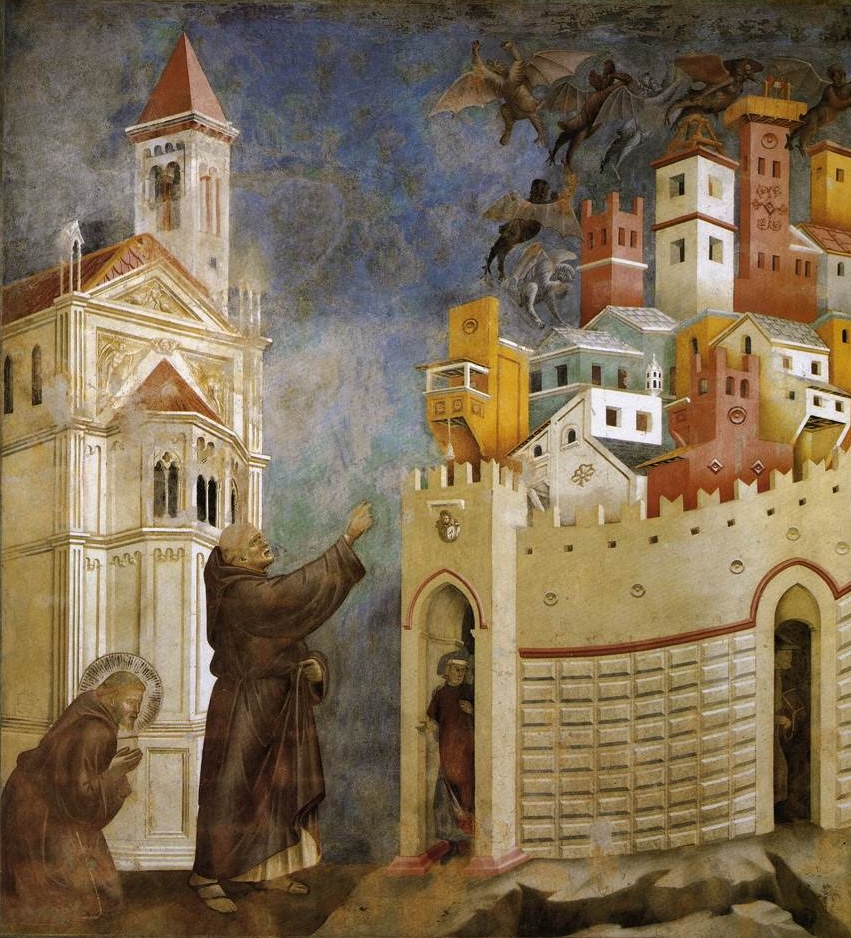
Header image: Giotto di Bondone, The Exorcism of the Demons at Arezzo, c. 1297–99, fresco from the Legend of St Francis cycle, Upper Basilica of San Francesco, Assisi. Public domain, via Wikimedia Commons. When the city of Arezzo was torn by a civil war that threatened to destroy it, St Francis of Assisi, staying outside the walls, saw demons over the city stirring the citizens to kill one another. He sent his companion, Brother Silvester, to the city gate to command them, in the name of God, to depart. The demons fled, peace returned, and the citizens reformed their civil laws.