

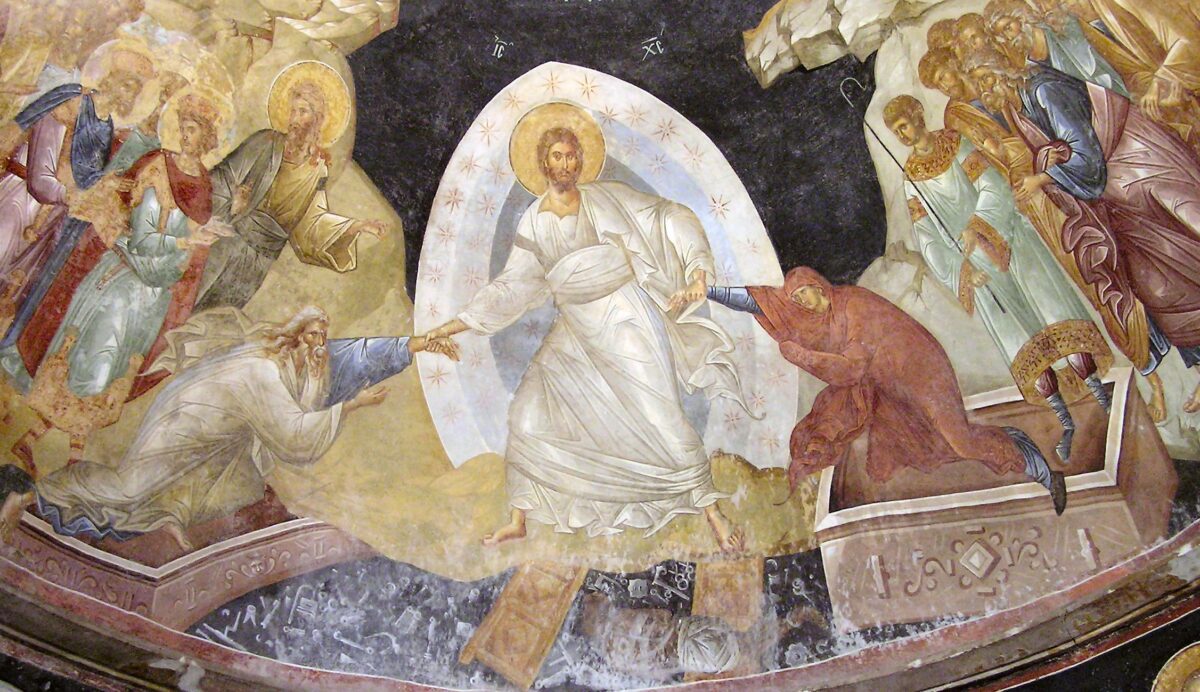
This is the editorial from our 2026 Easter Newsletter. For the full edition, click here
Scroll down for links to our latest resources.
Whose Christianity?
There was some excitement in recent months about a so-called “quiet revival.” Visions of a renewed Christian country emerging from this time of crisis were enthusiastically discussed.
The data turned out to be flawed and was withdrawn, yet the discussion it provoked was revealing. Hopes focused largely on numbers and a return to traditional, polite churchgoing, perhaps out of a desire for comfort, possibly also a need for control.
But the spiritual landscape in England is more complex. We are undergoing profound change. As Mary Harrington recently put it, we are “Disenchanted spiritually. Disembedded domestically. Dispossessed by our own government. Disaffected, disbelieving.”
This Easter, as we enter into the life of the risen Christ, who in His very person is the model of unity, Christians here are divided on questions of identity. So even before we speak of Christian renewal, we must ask a prior question: Whose Christianity?
The resurrection reminds us of the pattern of new life constantly breaking through: the Christian tradition is a living dynamic. Yet we see that pattern resisted in the muttering of leaders seeking to distance themselves from less polite forms of Christianity. While caution is wise, there is a risk of alienating those who are trying to enter the kingdom (Matthew 23:13). Something deeper may be stirring beneath the radar, something that growth-focused data cannot capture.
The idea that revival will come only from within the institutional churches is unrealistic. Many are fragile: ideologically confused, estranged from their neighbourhoods, with ageing congregations, overstretched clergy, burned-out volunteers, and dioceses close to bankruptcy. Notwithstanding some thriving metropolitan parishes, often thanks to migrant arrivals and Gen Z seekers looking for meaning, much of the infrastructure continues to decline.
Meanwhile, in post-industrial towns and outer estates, small fellowships are quietly appearing: some non-denominational, some Pentecostal, some Orthodox, sometimes no more than a Bible study above a shop or around a kitchen table. They offer informality, moral seriousness, straight talking, and an encounter with the Holy Spirit.
That this is happening precisely in communities most affected by deindustrialisation, globalisation and mass immigration is no accident. The rupture ran deeper than is often appreciated. It may be generating a stirring of what might be called the primal imagination.
That this yearning is sometimes expressed through flags or assertions of Christian identity is not surprising, given the vacuum of moral leadership where the mainstream churches should have been. The moral clarity of many of these fellowships is often sharpened by a shared loss of trust in those churches, particularly because of their silence around the rape gang scandals.
Yet these groups are not necessarily the ethno-nationalist caricatures their critics claim. Many are strikingly multi-ethnic, sometimes co-led by refugees and immigrants who have themselves fled Islamist regimes. What unites them is not ethnicity but a shared search for meaning, moral clarity and the presence of God.
Catholic tradition has long insisted that the poor often know their need for God more readily than the affluent and the busy, that they are less likely to have been educated out of their instinct for the transcendent. If Christian renewal is coming to England, it may not look like the restoration of an old ecclesiastical settlement. It may look more plural, grassroots and unpredictable, which should make us cautious about attempts at renewal being shaped from above.
The crisis we are living through is rooted in the false anthropology of the unencumbered self, which has colonised our culture and produced profound social, moral and political dislocation. If Christianity is to be an antidote to that crisis, it cannot be built on the same individualist foundations.
Christian anthropology is relational, so we need a relational Christianity, relational all the way down: in our theology, our practices, our political economy and our institutional life. That is why the principle of subsidiarity, at the heart of Catholic social teaching, matters so much.
Subsidiarity recognises that authentic social life grows through relationships and institutions that arise from below, through families, schools, churches, charities, businesses, clubs and associations, each playing a vital part in fostering meaning, responsibility and solidarity. This architecture of civic friendship has a cosmic dimension because this is where human beings connect. Government can enable such life; it cannot manufacture it.
A truly Christian identity is generous and capacious. It does not fear or reject a multi-faith society, but seeks to live with integrity and neighbourly respect toward people of other faiths while remaining firmly rooted in the truth of Christ. Churches have a vital role here.
We have seen it before. In the 1889 Great Dock Strike, Cardinal Manning and General Booth forged a civic friendship that strengthened solidarity among East End workers. A century later in Liverpool, Bishops Worlock and Sheppard helped a city in crisis not through state programmes but by supporting local people of all faiths and none to build their own institutions: educational, sporting, legal, business and housing. That is subsidiarity in action.
England does not need a triumphalist, integralist Christianity that would provoke blowback. Rather, our story has been one of quiet enculturation and Spirit-led change, from the re-assimilation of Catholic tradition, to the historic visit of Pope John Paul II, to the profound changes brought by the gifts and challenges of migration.
Which brings us to a mysterious part of the English Christian story. England has long been called the Dowry of Our Lady. That ancient title, rooted in Walsingham, suggests that renewal here may not come through state sponsorship or ecclesiastical restoration alone. It may also come through a spirituality that surrenders to God’s will and carries the experience of His agency into ordinary life. The Catholic tradition, despite its imperfections, has a rich treasure to offer here – its spiritual, moral and social wisdom is universal and intended for all.
This Easter season, therefore, we must pay attention to where the Holy Spirit is actually moving, not only in thriving parishes but also in the estates and informal fellowships across the country, in a variety of Christian forms.
***
Wishing you a blessed Easter
Jenny Sinclair and all the team at Together for the Common Good
In this edition
Discover our latest resources via the links below.
To read the full edition, and join our network, click here
David Ranson A Service Shaped by Christian Identity
Jide Ehizele Beyond Zero-Sum Thinking: Recovering a Christian Moral Imagination
Jenny Sinclair Whose Side is the Church On
Jo Stow From Hidden Need to Shared Life
Staying Human series new dates for your diary
Jo Stow Common Good Schools Easter update
Leaving Egypt podcast latest episodes
Jenny Sinclair Christian Calling and the Relational Imperative
This work happens thanks to a small number of wonderful supporters. To continue, we need to grow that number. Could you lend a hand by becoming a paid subscriber? From only £5 a month you can play an important role in enabling this work to continue and grow.
Join our network and subscribe here