

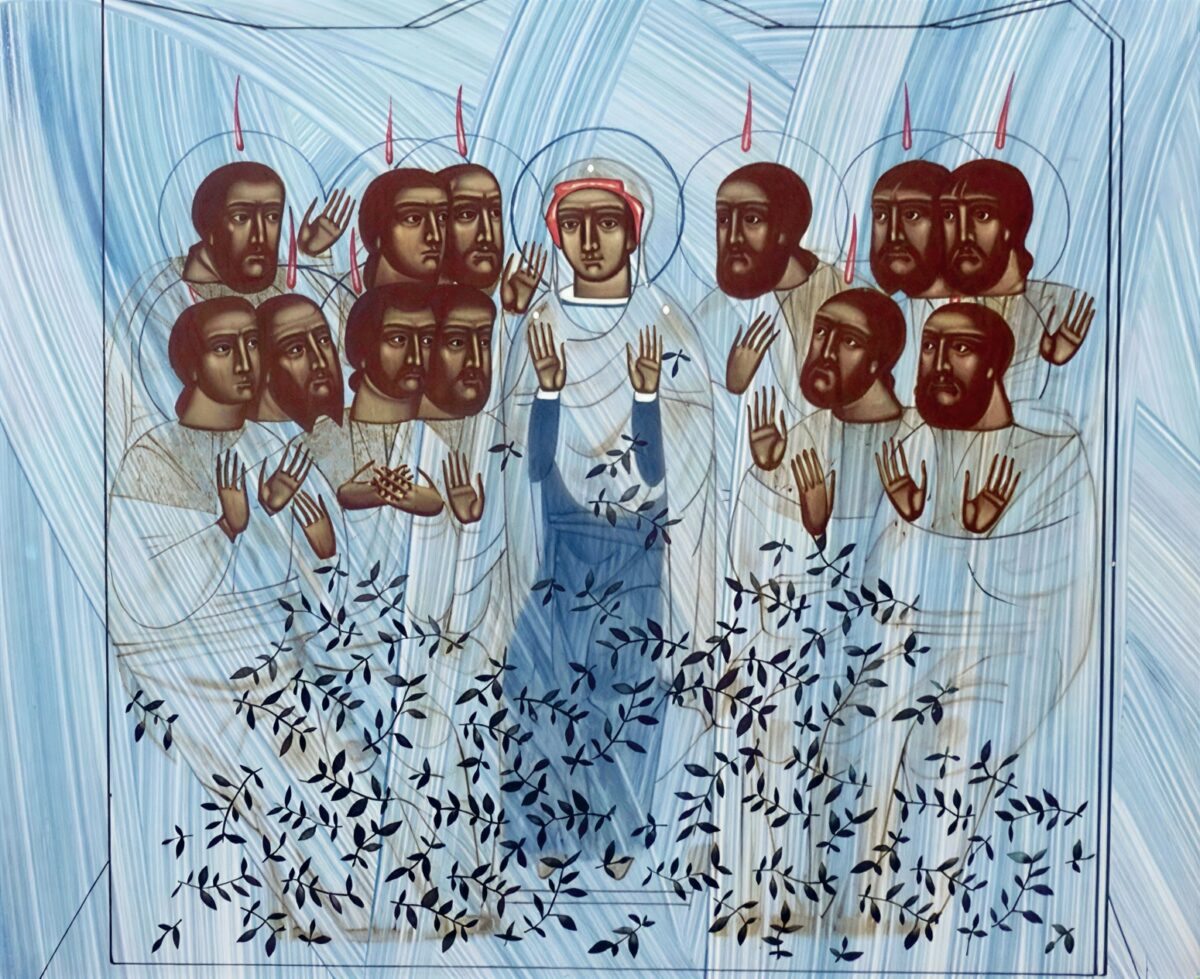
This is the editorial from our 2026 Pentecost Newsletter. For the full edition, click here
Scroll down for links to our latest resources.
Our Purpose
This Pentecost, we are reminded that our dependence on the Holy Spirit is more important than ever. Just as risen Christ invited the apostles to “receive the Holy Spirit”, so He asks us again now – in an age of rapid technological change. This is no abstract invitation. It is a practical command for our time. The Spirit is the one who gives the gift of conscience and leads us into the light of the moral order.
We are living through a period of unravelling – the consequences of an era shaped by hyper-liberal individualism. For decades, a culture of self has affected our social, economic, political and spiritual life: eroding the bonds of belonging, prioritising personal autonomy over mutual responsibility, and undermining human worth. The damage is visible – in fragmented communities, strained families, declining trust, and a widespread crisis of meaning. Into this already weakened social fabric now comes a new and powerful force: a new industrial revolution.
The disruption is already underway and moving faster than most predicted. Generative AI has achieved mass adoption in a fraction of the time it took the smartphone. Agentic systems are automating complex professional work. The trajectory points toward profound displacement across white-collar and, increasingly, manual sectors, where one person may do the work of five, ten, or far more. The transition is likely to be rough.
We must take this seriously. It is no longer viable to regard this as a specialist interest for science or tech experts. We are all called — across our traditions — to play our part, both in resisting what dehumanises, and in engaging wisely to ensure that the technology upholds the person, the family and community.
This sobering reality sharpens everything we at Together for the Common Good have long argued for: the urgent need for spiritual and civic renewal rooted in a coherent Christian witness. At the heart of that witness is an authentic Christian anthropology: the conviction that human beings are relational beings made in the image of God. We are not designed to be isolated individuals defined by category. We are called to work together, with God, in His creation, to take responsibility, to build relationships, and to exercise moral agency.
AI excels at the objective dimension of work — the tasks, outputs, and efficiencies. But it cannot fulfil the subjective dimension: it cannot exercise conscience, hear God, provide human warmth, shape conscience and character through years of struggle, or generate the embodied mutuality of real community. These realms are our responsibility.
This is why reliance on the Holy Spirit is not pious sentiment but practical necessity. Where human conscience is pressured by artificial systems, the Spirit helps us hold the line. We are being offered increasingly powerful tools, but we must not outsource our role in discerning the voice of the Spirit – vital for truly human decision-making.
The challenge before us is sobering. A society already hollowed out by individualism, deindustrialisation and globalisation now faces mass displacement of jobs – roles that have historically formed people in judgement, responsibility, and neighbourliness. An inadequate response to this new, epochal change risks deeper disorientation, anger, and unrest.
Yet this same pressure reveals the profound relevance of what the Church is uniquely equipped to offer: local, embodied, relational communities that ground people in a meaning that is deeper than economic function. The Spirit reorients us toward vocation — to contribute, to tend, to build together.
As Christian leaders — ordained and lay — we must lean into our calling with the renewed clarity that this context demands. What does it mean to be a Christian in this new time? Our churches, groups, charities, church schools, and organisations are well-placed to be vital neighbourhood anchors. Not fading institutions managing decline, but living centres of formation, belonging, and common life.
We can help people to understand the deeper purpose of human life. Our gatherings, our local relationships, our discipleship, our worship, preaching, mentoring, and leadership must prioritise the subjective: discernment, moral clarity, attentive presence, conscience shaped by Scripture and prayer, and the habits of mutuality and community. Our countercultural witness must be rooted in an authentic Christian anthropology, where we devote ourselves to relationship, and to making and doing, rather than consuming.
Our congregations must be places where meaning is found. When familiar structures of work change, something fulfilling must provide motivation. An outward-facing local church community, living out subsidiarity in practice, can help to organise local life around shared purpose, mutual obligation, and the dignity of contribution. We can partner with neighbours through forms of co-ownership to manage local energy and food supply and develop new local economies. Our institutions are uniquely placed to play a key role. The times call for a new, Spirit-led imagination.
We must engage the wider conversation with moral clarity. We need informed Christian voices who insist that inherent human dignity does not depend on economic output, and who can discern how technology should serve the person rather than redefine them. This requires both resistance to AI overreach and wise engagement with the technology in ways that uphold and enhance our common life.
The AI revolution sharpens our long-held vision. The new pressures now arriving, on top of the unravelling we are already witnessing, call us back to the heart of the Gospel: Christ is King, the one who restores communion through the gift of the Spirit. In receiving that Spirit, we become better able to uphold conscience and embody hope.
When Rerum Novarum — the first encyclical in the modern era of Catholic Social Teaching — was published, it represented a historic intervention to defend the human person in the face of the Industrial Revolution. Now, we anticipate that the next encyclical will continue that tradition. Magnifica Humanitas (Magnificent Humanity), will address the AI revolution. To be published next week, it will provide valuable gospel-rooted guidance as we discern our response to the challenges of our time.
Wishing you every blessing this Pentecost. May you receive the Holy Spirit afresh, and with your neighbours, step forward together for the common good.
Jenny Sinclair and all the team at Together for the Common Good
In this edition
Dates for your diary Staying Human series continues
Matthew Sanders Staying Human: AI, the Future of Work and Christian Discernment (lecture)
Jide Ehizele Sharing a Life Together
Jenny Sinclair The New Industrial Revolution, Catholic Social Teaching & Political Unravelling
Leaving Egypt episodes Melanie Rieback, Mgr John Armitage & Sophie Taylor
Jo Stow Common Good Schools: Pentecost update
Jenny Sinclair Caritas, People and Place
Signs of the Times selected articles
Jenny Sinclair Christian Witness in the Unravelling
To read the full edition of this newsletter, click here
This work happens thanks to a small number of wonderful supporters. To continue, we need to grow that number. Could you lend a hand by becoming a paid subscriber? From only £5 a month you can play an important role in enabling this work to continue and grow.
Join our network and subscribe here