

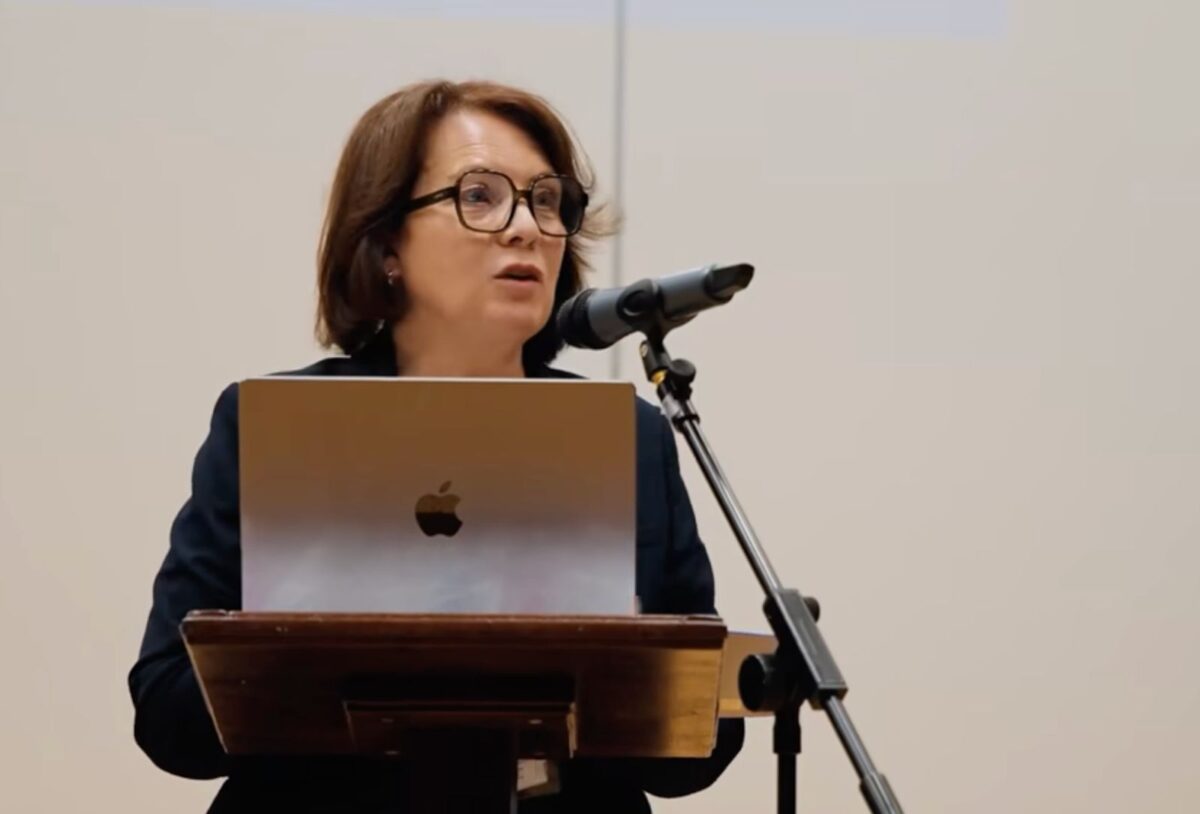
Speaking at this year’s WeBelieve Festival, Jenny Sinclair reflects on what it means to become a neighbour in an age of individualism, disconnection and profound cultural change. She argues that rebuilding relationships, strengthening local institutions and recovering the Church’s outward-facing vocation are essential to renewing friendship, human dignity and the common good.
It’s a real honour to be here with you today, and thank you to the WeBelieve team for the invitation.
Before I start, a little about me. I am a convert to Catholicism. I grew up in an Anglican family – my father was David Sheppard, Bishop of Liverpool, whose 22-year partnership with Archbishop Derek Worlock became widely known for ending sectarianism in that city, and for playing a pivotal role alongside communities at a time of division and instability.
But I was a rebel in my teens, more interested in Liverpool’s music scene. I became estranged from the church. Later, in my mid-twenties I had a conversion experience – a dark night of the soul – and I was received into the Catholic Church. That was 38 years ago.
It wasn’t until much later, in my late forties, that I felt the Holy Spirit calling me into the work I do now. I don’t say that lightly – I’m not an especially pious person, and I’m wary of grand religious language. But I do experience this work as a vocation. I’d noticed that something was going wrong in our society, and that our churches were struggling to respond. So, in 2011 I founded Together for the Common Good – which has become a small charity dedicated to spiritual and civic renewal, drawing on Catholic Social Teaching to help Christian leaders, churches, schools and charities read the signs of the times and play their part for the common good.
Everything I’m about to say grows out of fifteen years of listening and learning – sitting with clergy, laity, head teachers, charity workers, business leaders and community organisers – Christians across all traditions, all trying to answer the same question in their own context: what does it actually mean, now, to love our neighbour?
Neighbour
I want to use that word, neighbour, as our way in today. It’s an old word – one everybody understands without a theology degree. Neighbour is a way into what I call the relational imperative – the conviction, running through the whole tradition of Catholic Social Teaching, that we are made for relationship, not autonomy. We are not designed to be an isolated, self-authoring individual, but a person who becomes fully themselves only in communion with others and with God. That is our Christian anthropology – relational, transcendent, made in the image of a Triune God who is a relationship of persons.
If God is relational – Father, Son and Holy Spirit, an eternal communion of love – then a being made in his image therefore cannot, at root, be a solitary actor. We are built for connection. Neighbourliness in its fullest sense isn’t an add-on to the moral life. It is the moral life.
Every principle you’ll have heard of in Catholic Social Teaching – the common good, solidarity, subsidiarity – bears aspects of the relational imperative, worked out in different ways: the common good is a shared life we build together; solidarity is about mutual relationships of concern and support; subsidiarity is making sure that responsibility stays as close as possible to the person and the local, rather than being subordinated to the market or the state.
The change of Era
So why does this relational anthropology matter so urgently now? Because we are living through what the late Pope Francis described as not just an era of change, but a change of era.
The old era has been shaped, for over four decades, by a philosophy of hyper-individualism that promotes a false idea of freedom – understood as freedom from constraint – freedom from family, from place, from tradition, from God. It offshored our industries in the name of a “frictionless” global market, and it cut the ties that bind us to place and to one another. Whole communities were subjected to the consequences of a dogma that rendered their work, their skills, their rootedness, obstacles to progress. I’d call that a politics of abandonment.
This philosophy – progressive globalisation, as it became – has weakened connection, hollowed out neighbourhoods, and left rising numbers of people, especially the young, adrift, anxious, and hungry for meaning. This isn’t only an economic story. The same logic has reshaped our social, moral and spiritual life too. This is what happens when a society’s operating system is built on a false idea of the human person – a false anthropology: the human being as an “unencumbered self”, a desiccated, soulless idea of the person, reduced to a set of preferences and rights competing in a marketplace, rather than a relational creature made for communion. We have been evangelised as consumers. It goes against the grain of who we really are – and so it contains the seeds of its own destruction.
We’ve seen this philosophy played out too, in the commodification of the human being – in the liberalising of abortion and the promotion of assisted suicide, in commercial surrogacy, in a culture of extreme body modification that treats the person as raw material rather than a gift. We also see it in the atrophy of local, human-scale institutions – the club, the local association – which have been undermined by the digital and the distant.
And we have seen it in the breakdown of trust, in the rise of identity politics – identity groups living separate lives and a growing tribalism. We see this dogma provoking a rising discontent, as legitimate concerns are branded backward or bigoted when in fact they often reflect an instinctive grief at the loss of civic peace. Some see this more easily than others: what you see depends on where you live, who you know, and what media you consume.
And now, on top of that already atomised, unstable substrate, comes the AI revolution. We are going to be offered ever more sophisticated ways to simulate relationship without risking the real thing – without what the theologian Luigino Bruni calls “the wound of the other.” Narcissus, turbocharged: a culture of the self, gazing at its own reflection, now handed a mirror that talks back, flatters us, and asks nothing of us in return. That is a serious spiritual danger, not only a technological one.
Matthew Sanders, who works at the forefront of Catholic AI, in a lecture for us recently, named four marks of what must remain human, in terms of work – what must not be outsourced:
1. relationship, where trust and presence matter;
2. moral judgement, wisdom and conscience;
3. accountability, someone who actually answers for a decision;
4. and meaning, work that contributes to identity and belonging.
Those four are not up for negotiation. The relational imperative is at the heart of our identity.
Neighbourliness, then, is not a nice-to-have, a pleasant extra for people with time on their hands. It is a strategic response to a culture that has lost its way.
I know this diagnosis can sound bleak. We’re living through something of an interregnum with great uncertainty – but I offer it because it sharpens, rather than dampens, our sense of mission. If you know what’s actually broken, you know what you’re for.
The yearning
Here’s the strange thing. Just as the old story is exhausting itself, we’re seeing something new – a spiritual hunger, especially among the young, and especially in abandoned communities. In both, we see a rejection of chaos and a desire for the restoration of a settled life. We see a growing interest in traditional forms of Christianity among Gen Z. But we also see people coming to Christ in post-industrial, working-class communities – this time through independent evangelical churches and informal bible study groups. The Holy Spirit, it turns out, is not confined to the nice, tidy, middle-class parish. All are yearning for order, truth and belonging.
Some of us might feel triumphant about that – “look, people are coming back to us.” Yes, the draw to tradition, to beauty, and to moral clarity, can be a real grace and a genuine gateway. It can also, if we’re not careful, become another identity category. I say this as someone who believes that this tradition is what this country needs: but our task is not to be triumphalist, nor is it to retreat into a fortress.
Rather, our response must be to hold fast to what is true while still reaching toward those who haven’t yet arrived. What people are actually hungry for, underneath the aesthetics, is what the Church at its best has always offered: to be truly known, truly accompanied, and loved into the truth. That is also a dimension of neighbourliness.
Why this moment matters
I want to give you one more piece of the picture, because I think it helps to explain why this moment is so consequential. The economist Karl Polanyi observed that when human beings are stripped of protection – when the economic story that gave their lives meaning collapses – and when their old solidarities are dismissed as backward, they don’t quietly go away. They have something to say. The dispossessed regroup and look for another form of solidarity. That can go one of two ways. It can harden into something narrower and more primal – nation, tribe, grievance, sometimes worse. Or it can turn toward the Kingdom – toward faith, toward the parish, toward neighbour.
I think that is the choice in front of the Church right now, and it’s why this moment matters so much. Whether the anger and dislocation of our time ferments into something ugly, or becomes the raw material for genuine, humane renewal, may depend on whether the Church shows up as neighbour to people in that dislocation – or leaves them to find solidarity elsewhere. We’ve not always got this right. When deindustrialisation hollowed out whole regions, too often the Church’s answer was charity and welfare rather than solidarity – a form of help that actually entrenched dependency rather than restored agency.
Magnifica Humanitas and Nehemiah
Pope Leo XIV, in his first encyclical, Magnifica Humanitas, puts his finger on exactly this. He chose his name to echo Leo XIII, whose Rerum Novarum set out the Church’s position on the Industrial Revolution 135 years ago. Leo XIV’s encyclical is the Church’s answer to the AI revolution. But read it, and you find that although its focus is on artificial intelligence, it is, in fact, about anthropology: it is a masterful statement about what it means to remain human when the rise of unaccountable, global power threatens to undermine human agency.
Pope Leo reaches for two powerful images from Scripture:
· The Tower of Babel – a people trying to build power through uniformity, domination and self-sufficiency without God, ending in confusion and scattering.
· The rebuilding of the walls of Jerusalem under Nehemiah – ordinary people, priests and artisans and heads of households, each taking responsibility for their own stretch of wall, listening to one another, building relational power together, under God.
That image is instructive for us. None of us is asked to rebuild the whole wall. We are asked only to find our own short stretch of it — as a personal vocation, and also institutionally: as families, as a parish, a school, a charity, a business, an association – those bodies that Catholic Social Teaching calls intermediary institutions.
These human-scale bodies between the person and the state have a very important role, each with its own unique vocation for the common good. This is a thread running right through Catholic Social Teaching, from Pope John XXIII, through Pope St John Paul II, to Pope Leo XIV today, who names the strengthening of this layer of institutional life as the way to resist unaccountable power, such as the oligarchic power of the AI companies.
You may feel, honestly, that you’re not prepared for this moment. Well of course we’re not – none of us is. But as the historian Arnold Toynbee argued, the survival of any civilisation depends on a creative minority – a small, proactive group who responds well to a crisis. Pope Benedict XVI took up that phrase and applied it to us directly. He said, “the Catholic Church must understand itself as a creative minority that has a heritage of values that are not things of the past, but a very living and relevant reality.” Look around this marquee. This gathering is what a creative minority looks like – slightly overwhelmed, probably under-resourced, but exactly what the moment requires.
What does your stretch of the wall look like?
Let me walk through a few examples, because I think it looks different depending on where God has placed you.
If you’re a young person, or you work with young people, it might begin with understanding, early, that you have a vocation and a part to play in the common good, not just a career to build. That’s why we run our Common Good Schools programme, equipping teachers to form children and young people in the basics of Catholic Social Teaching, giving them an authentic understanding of the human being, and practical ways to take responsibility, to build relationships, and act as neighbours in their own school and neighbourhood.
If you are a teacher, then your part of the wall looks different again. I’ve been doing some work recently with Catholic multi-academy trusts, helping them to see their vocation is not only as providers of education, but also as intermediary institutions, each having a calling to build relationships across their local area, with local employers, with parishes, with businesses. A trust educating thousands of children has the strategic heft to build up the common good directly: backing local suppliers, developing apprenticeships, fostering ethical forms of local business – the kind of embedded, human-scale economic activity that stays accountable to place, rather than to some distant, unaccountable power.
If you’re approaching a stretch of wall as a person or as a family — I’d point you to a guest on our podcast, Leaving Egypt: Andrew Willard Jones, a brilliant young theologian, who with his wife is raising eleven children in the rust-belt town of Steubenville in Ohio. Andrew maintains that human happiness is “sitting around table with friends and family having dinner.” His account of the Christian response to a broken culture comes down to intentionally cultivating and expanding the “structures of friendship that still exist.” He says to start small: take one acquaintance, and decide to make them a friend. This is the reweaving. This is neighbourliness, one relationship at a time.
Also, Monsignor John Armitage’s story is in there too. Monsignor John’s answer, as a parish priest, is deceptively simple too: he says, “open your door at six in the morning and close it at ten at night,” and let people find, in community, what a screen can never give them.
If you’re part of a parish, your calling is both inward and outward. Internally that means making everything you do – liturgy, events – an occasion for communion, and forming your own people in this vision of what it means to be human; and yes, I am talking about intentional formation in Christian anthropology. And in outward-facing terms, it means the parish proactively engaging with the neighbourhood. For example, I’ve spent some time recently with the clergy of Arundel and Brighton, exploring what this might look like in practice. This could be something as simple as parishioners mapping their own neighbourhood and asking honestly, “who do we know, and who don’t we know?” — through to a more targeted initiative: a Catholic-led initiative in Leeds that helped to turn a failing public swimming pool into a thriving cooperative employing sixty people.
These are patient, unglamorous acts of restoration that begin to reconnect that which has been separated. These local, human-scale associational forms together form an architecture of civic friendship – which has a cosmic dimension because this is where human beings connect.
And if you run or support a Christian charity, your part of the wall is to address the drift into the transactional, service-provider model. The food bank that never asks anything of the person receiving, the underlying “us and them” of the homeless shelter, that despite kind intentions, disempowers the people it aims to help. Through our Crossroads project, we’re exploring how to encourage Christian charities of all traditions to recover a more relational, reciprocal model of charity – helping people contribute as well as receive. Truth as well as grace. Because, as Pope Benedict XVI said in his explanation of subsidiarity, everyone – however vulnerable – has something to give. That’s how people find their dignity. In the new era, we are called to move from service to communion.
And if you’re a leader in any sector – whether you’re in finance, law, tech, medicine, business, media, education, or you work for a diocese – then the living tradition of Catholic Social Teaching is your friend as you tackle your part of the wall. Through our Staying Human lectures, I’ve been convening leaders across denominations to engage with the big questions of our time. Questions like political economy, personhood, the ethics of life and death, what AI means for the future of work – using the non-partisan tradition of Catholic Social Teaching as a framework for good judgement. After all, it is meant for all people of goodwill, not just for Catholics. And I’ve learned that people in senior positions really value coming together to have these deliberative conversations – which in their world, are surprisingly rare.
Not Proseletysing, but Neighbour
I want to be careful about one thing. In the Catholic tradition, evangelisation is a holistic concept. Yes, it is about sharing the gospel. But it’s also about how we live, about challenging structures of sin and building structures of grace. Being a good neighbour to someone therefore is not a means to an end. If we only love our neighbour in order to convert them, we haven’t yet understood what neighbour means.
But – and here’s the paradox: a Church that has recovered genuine neighbourliness will evangelise anyway, almost without trying, because people are starving for exactly this. Many newcomers say they first encounter the faith online alone, before they ever set foot in a church. And sometimes, when they arrive, they may find it hard to adapt to the warmth of a real community, having become so used to digital isolation. Our evangelisation has to be holistic: not a private club with a members’ entrance, not simply proclamation from a platform. Everything we do – our schools, our charities, our parishes, our friendships – must be infused with this relational imperative, it must be outward-facing and grounded in a true understanding of what it means to be human.
Being relational also means building bridges with those who’ve become estranged from the Church for whatever reason, or perhaps if the Church may have lost touch with them. That may be a Gen Z longing for tradition that the parish hasn’t noticed, or a working-class view of the Church as a middle-class institution that hands out food parcels but doesn’t stand in solidarity on the things that matter to them. It may require courage to bridge these estrangements. But the answer isn’t to denounce or to lecture. It’s to welcome with warmth, grace and truth – to listen, to hear a person’s story, and let trust build.
As Pope Benedict said, the Church grows not by proselytising, but by attraction – by the unusual breadth of people it holds together – in unity, not uniformity. We may be at an inflection point: Catholicism in this country now has a distinctive and countercultural calling to offer moral leadership at a moment when so much else has run dry.
Closing
Let me close with where we stand, historically. The days of the recusant Church in this country – the underground, minority, defensive Church – are over. But neither is this a time for a fortress mentality, nor for an integralist, triumphalist Christianity. The English story has always been one of quiet wisdom rather than force – from the ancient English saints, through persecution, emancipation, and the long, patient work of rehabilitation.
The English charism is quietly alive. England has long been called the Dowry of Our Lady, and that old title suggests renewal here was never going to come from a top-down effort. More likely, I sense that renewal may come in two ways:
- through a spirituality that surrenders to God’s will and which brings the experience of God’s agency into ordinary life
- and also, through an expression of political economy inspired by Catholic Social Teaching’s relational imperative – that means building up from the ground, through local economies.
I think this festival is itself a beginning, a taste of what I’ve been describing. Part of why WeBelieve runs over a long weekend is that people need time to dwell together – and that experience of dwelling as a Church strengthens our communion even as our Lord calls us outward. You chose to come here because some part of you already knows this is a shared mission, and that this country needs a Church oriented to that outward movement – as neighbours, parishes, schools, charities and businesses, with each one of us fulfilling a unique vocational responsibility to build up the common good rather than waiting for it to be handed down from above.
So my invitation to you, as you think about your own little stretch of the wall, is simple. Ask the Holy Spirit to guide you to one new relationship this week, and build it. Notice one person you don’t yet know very well, or a local institution you could connect with. We are, each of us in our own ordinary corner, called to be builders of communion.
Jenny Sinclair
Founder and Director, Together for the Common Good
Jenny Sinclair is Founder and Director of Together for the Common Good (T4CG), a charity dedicated to spiritual and civic renewal. Drawing on Catholic Social Teaching, T4CG resources Christian leaders, churches, schools and charities to read the signs of the times and play their part for the common good. Jenny convenes events, writes and speaks about the vocation of the Church in society, and is co-host of Leaving Egypt, a podcast exploring what it means to be God’s people in times of unravelling.
Explore more content like this by subscribing to Together for the Common Good on Substack.